
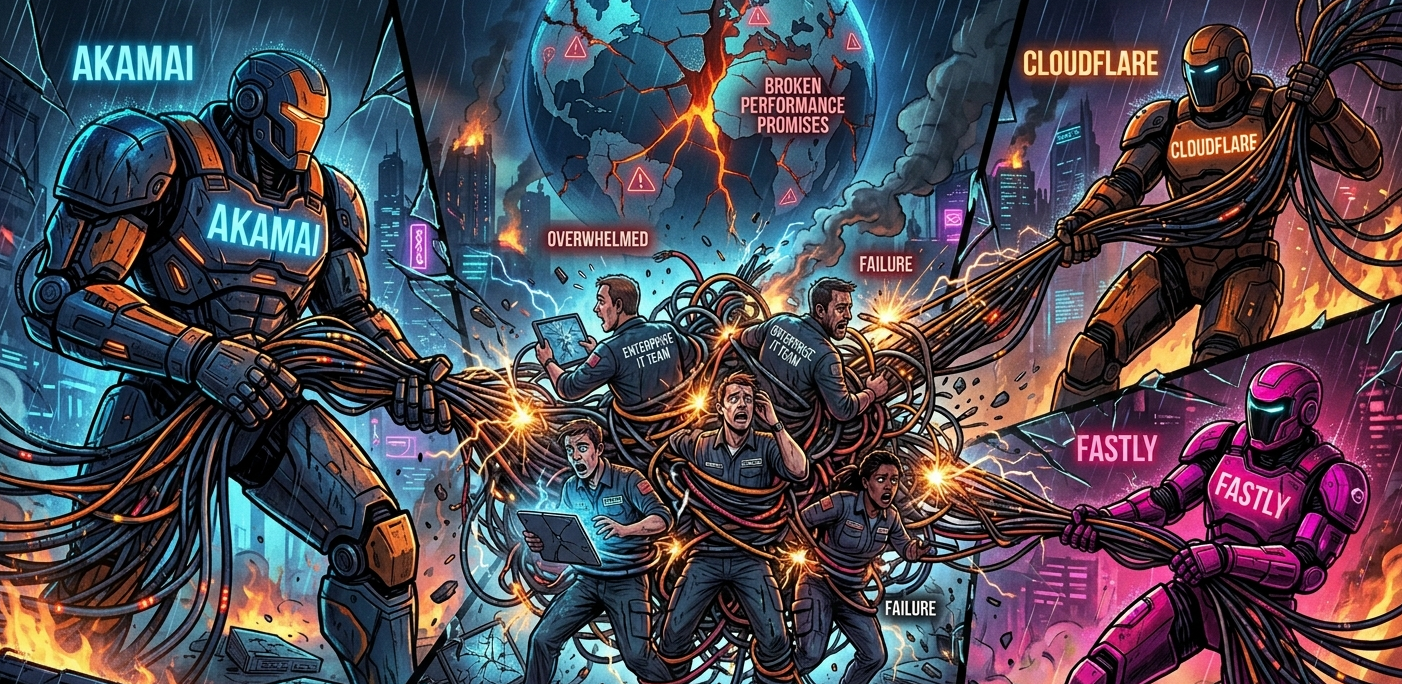
The Multi-CDN Myth That Refuses to Die
For years, enterprises have been sold a simple idea: more CDNs = better performance, higher resilience, lower risk. On paper, combining providers like Akamai, Cloudflare, and Fastly sounds like a no-brainer.
In reality, most Multi-CDN strategies are quietly failing.
Not because the providers are weak—but because the strategy itself is often flawed, over-engineered, and poorly aligned with actual business needs.
The Promise vs The Reality
What Enterprises Expect:
- Automatic failover across CDNs
- Lower latency via intelligent routing
- Cost optimization through vendor competition
- Improved availability
What Actually Happens:
- Traffic steering that barely works as intended
- Cache fragmentation across providers
- Increased operational complexity
- Costs that spiral instead of shrink
The uncomfortable truth?
Multi-CDN often introduces more problems than it solves.
Problem #1: Traffic Steering Is Not as Smart as You Think
Most Multi-CDN setups rely on:
- DNS-based routing
- Geo-based policies
- Basic health checks
These mechanisms are slow, coarse, and reactive—not intelligent.
They cannot:
- Adapt in real-time to performance degradation
- Account for last-mile ISP issues
- Optimize per-user experience dynamically
So instead of “best CDN per request,” you get:
“good enough CDN per region… most of the time.”
Problem #2: Cache Fragmentation = Performance Loss
Each CDN builds its own cache.
That means:
- Lower cache hit ratios
- More origin pulls
- Higher latency for users
Ironically, adding more CDNs can decrease performance consistency, especially for dynamic or long-tail content.
Problem #3: Operational Overhead Nobody Talks About
Running a Multi-CDN setup means managing:
- Multiple configurations
- Different rule engines
- Vendor-specific quirks
- Separate analytics dashboards
Your team spends more time:
- Debugging inconsistencies
- Aligning configurations
- Fighting vendor differences
Instead of improving user experience.
Problem #4: The Cost Illusion
Multi-CDN is often justified as a cost optimization strategy.
But in practice:
- Minimum commit costs stack across vendors
- Traffic duplication increases origin egress
- Engineering overhead grows
- Tooling costs rise
The result?
You’re not optimizing cost—you’re distributing it across more vendors.
Problem #5: Resilience Theater
Yes, Multi-CDN can improve redundancy.
But here’s the real question:
Are you solving a real availability problem—or preparing for a hypothetical one?
Most enterprises:
- Rarely experience full CDN outages
- Over-engineer for edge cases
- Under-invest in actual bottlenecks (origin, backend, app performance)
So, Is Multi-CDN Dead?
Not entirely.
But the default assumption that every enterprise needs Multi-CDN is dead wrong.
Multi-CDN makes sense only when:
- You operate at massive global scale
- You have advanced traffic engineering capabilities
- You can justify the operational overhead
For everyone else?
It’s often:
An expensive architecture built on outdated assumptions.
A Smarter Approach: Vendor-Neutral, Outcome-Driven Strategy
Instead of blindly adopting Multi-CDN, organizations should focus on:
- Workload-specific CDN selection
- Real performance benchmarking (not marketing claims)
- Cost transparency across traffic patterns
- Simplified architecture where possible
This is where a vendor-neutral perspective becomes critical.
Because the goal isn’t:
“Use more CDNs”
The goal is:
“Deliver better performance at the lowest possible cost.”
Final Thought
Akamai, Cloudflare, and Fastly are all powerful platforms.
But combining them without a clear, data-driven strategy doesn’t create magic.
It creates complexity.
And in modern cloud architectures, complexity is the most expensive mistake you can make.
About Astrav
Astrav helps organizations cut through vendor noise with vendor-neutral, cost-efficient cloud and performance strategies.
We don’t sell tools.
We help you choose, optimize, and justify them—based on data, not hype.